A few minutes of reading it turned into a few hours of thinking, writing and research and I thought I would publish my reply to him about one specific section in this book as an article on my blog as it covers a few interesting concepts and recurring themes.
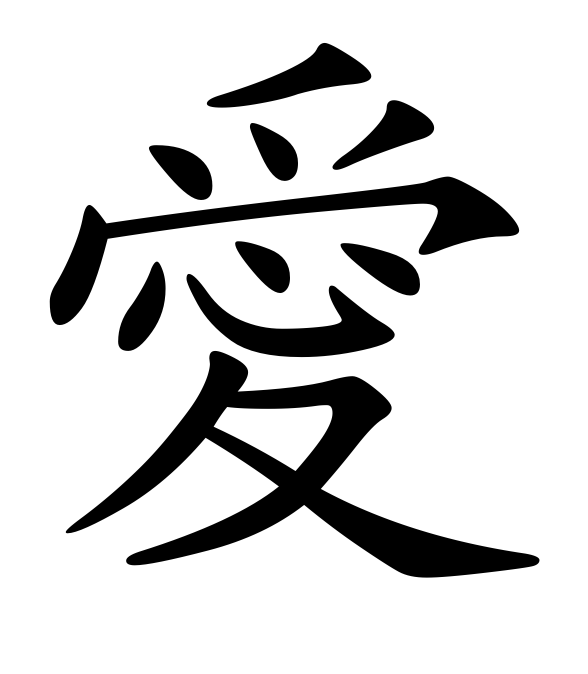
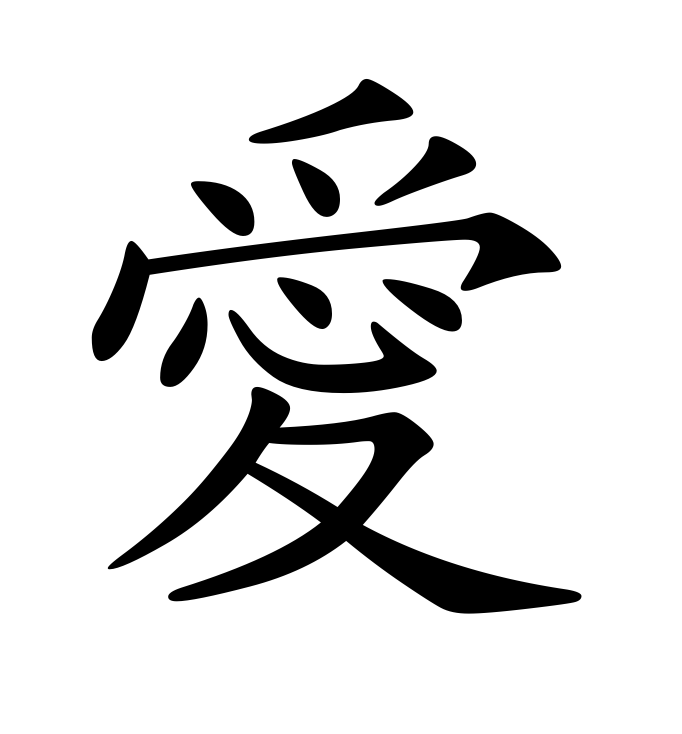
In the introduction, the author uses the character 愛 as an example to teach his students that quote "100% (not a single exception) of Chinese words is composed of root words. (sic)". The author's writing is a bit difficult to understand, and there was context before and after this sentence that would make it a bit clearer, but what the author essentially tried to say was that with every single Chinese character, it is possible to tell what this or that Character means just by understanding what roots it consists of, which can always be seen clearly in the character itself. A simple example would be looking at the Chinese character 人 and seeing that it is a person.
The author then proceeds to further demonstrate this with the character 愛 and as we will see, his system unfortunately falls apart. He writes:
愛 (love) is the composite of (sic):
1. Top part of 受 (receiving) which means holding hands (sic)
2. 心 (hearts (sic))
3. Bottom part of 夏 (Summer) which means walking slowly (sic).
So love is that hearts hold hands and walk slowly together (sic).
I think it should be obvious that this is storytelling and not scientific research, and I think it is also important to prove why the author is wrong.
First of all, arbitrarily deciding that the 愛 character is formed by ripping off the top of 受 and the bottom of 夏 and putting a 心 between them because it fits our explanation is like working with a completely faulty set of equations while solving a math problem and then arbitrarily changing the resulting number after the equal sign to the one we want manually so that it fits our teacher's correct result.
As for the etymology of 愛 I never researched this character before, I convened my little etymology research team consisting of me and my TW friend:) and this is what we found out:
First, let's make the character a bit bigger: