April 05, 2025

I Did a 5 day 121.5 Hour Water-Only Fast: Here’s How It Went and What I Learned

About a month ago I did a 121.5 hour (5+ days) water-only fast and it was such an intense, insane, comprehensive and unique experience, that I decided to write an article about it. I monitored a lot of my metrics closely, did a blood test right before the fast was about to end and then did a control blood test 2 weeks later and I found out some interesting things that I thought were worth sharing.

Reasons

I’ve been doing intermittent fasting (16:8) everyday for 5 years now, main reason being that by doing so, one can achieve a lot of the benefits a prolonged fast (2+ days) can give you, without doing the actual prolonged fast itself. 

So naturally, I thought I would like to do a prolonged fast at some point too, as intermittent fasting or supplements mimicking benefits of prolonged fasting like resveratrol, fucoidan, metformin, spermidine etc., cannot compare in result intensity with what a real prolonged fast can do.

I did several 1-day fasts in the past and two 2-day fasts as well and wanted to try an even longer one. I decided to go for a 5 day fast mainly because of these reasons:

  • Autophagy (cellular cleanup): during a prolonged fast, our bodies recycle all sorts of cellular ‘junk’ which isn’t really touched in times of nutritional abundance, like misfolded proteins or dysfunctional mitochondria. These can cause all sorts of problems like inflammatory responses from our immune system etc. 
  • Sirtuin activation leading to DNA “repair”: Sirtuins regulate what a given cell is producing by switching the production of a given ‘thing’ on or off. They are basically little cellular molecular machines which physically turn genes in our cells on and off. The information theory of aging suggests, that as we grow older Sirtuins do not perform this function as well as they should and our bodies globally decline. A skin cell that is supposed to produce only skin cell proteins now maybe produces proteins that a bone cell should produce and vice versa. When our bodies are in ‘repair mode’ due to the lack of nutrients, Sirtuins are especially active.
  • Stem cell activation, immune system reset: During a prolonged fast, the body also gets rid of dysfunctional immune cells, boosts immune stem cell production and replaces these cells with new well-functioning ones, effectively leading to an immune system reset.
  • Reduced inflammation: due to ketosis (energy production from fat) and autophagy body inflammation is reduced
  • Surge in human growth hormone levels (HGH): during the fast, HGH is overproduced up to 5 - 10 times more compared to our baseline values. HGH is a hormone which mobilizes our body’s resources to repair all kinds of tissues. While we fast, not much is going on in this regard, because we lack nutrients to do the repair, but after we reintroduce food into our system, adding supplements like protein isolate and collagen peptides, the lingering overproduced HGH then utilizes these to supercharge the repair process.
  • To give my digestive system a break: just in general, as I will write later, giving the digestive system a chemical and physical break is a return to normalcy.

October 23, 2024

The mysteries of being perceived as a native speaker

I was working with the Airport police yesterday with an asylum seeker from Afghanistan. I spoke Farsi, she spoke Dari. I had heard Dari before and knew this sort of Farsi-Dari communication was possible and as no Dari interpreter was available, I was called in. I knew it would be hard but I have to admit, I did't expect I'd have so much trouble understanding her. 

After about 20 minutes the lady said in Dari, "let me try to speak in English, because Dari seems to be hard for you to understand". I automatically thought, well.. my Farsi is poorer than I thought. 

The thing is, if you speak Farsi really well, in theory you should be able to understand Dari pretty well too, so I thought it was clear the problem was my Farsi and not the fact that I didn't understand Dari too well. 

I continued speaking in Farsi and she spoke in English. After about an hour she asked: Where are you from? I said "Here." and pointed to the ground. To my surprise, she asked: "You are not from Iran?" 

October 16, 2024

Two third tones rule in Mandarin.

An interesting thing happened to me yesterday. For the first time since I started learning Mandarin - and that would include 3 years of demanding studies at our university's Chinese department, 5 years of complete immersion in Taiwan and 10 years of working as an interpreter for the police, judiciary, prosecution.. all in all a daily grind of 17 years..  I managed to 'feel' and not 'know' that a 3-3 tonal combination in Mandarin should be a 2-3 combination. 

In other words, I 'felt' and not 'knew because I had learned the rule', that when there are two third tones in close proximity in Mandarin, that it "can't be like that" and that the first of the two tones must be pronounced as the second tone. (The full rule is a bit more complex, but for the sake of simplicity, this is what I want to go with for now). 

Before that, all that time, the whole 17 years, since I started studying Mandarin, when I spoke Mandarin, I had to pay attention to what tones would follow in my speech, and all that time when a 3-3 combination was approaching, I had to consciously 'initialize' the 3-3 > 2-3 rule and pronounce the combination as 2-3. 

Even after 17 years it was still a bit difficult and a bit tiring in the sense that it cost me my attention, and it put slight pressure on the syntax and the overall sequence of thoughts around the 3-3 point in my speech. 

Yesterday, as a form of practice, I was reading out loud a transcript of a podcast with a native-speaker friend. We've been reading it regularly for about 2 weeks now and suddenly I came to a point in the text where "Alice很努力" appeared and because I was reading too quickly I went on to read it as "Alice hěn nǔlì " and I said... "Wait a second, that can't be." 

November 02, 2023

Analysis of Lion-Eating Poet in the Stone Den 施氏食獅史


The following is my short analysis of the famous Lion-Eating Poet in the Stone Den (施氏食獅史) poem. 


About the poem:


"Lion-Eating Poet in the Stone Den" (Chinese: 施氏食獅史; pinyin: Shī-shì shí shī shǐ) is a short narrative poem written in Classical Chinese that is composed of about 94 characters (depending on the specific version) in which every word is pronounced shi ([ʂɻ̩]) when read in present-day Standard Mandarin, with only the tones differing.[1]


The poem was written in the 1930s by the Chinese linguist Yuen Ren Chao as a linguistic demonstration. The poem is coherent and grammatical in Classical Chinese, but due to the number of Chinese homophones, it becomes difficult to understand in oral speech. In Mandarin, the poem is incomprehensible when read aloud, since only four syllables cover all the words of the poem. The poem is more comprehensible—but still not very intelligible—when read in other varieties of Chinese such as Cantonese, in which it has 22 different syllables, or Hokkien Chinese, in which it has 15 different syllables.


Source: https://en.wikipedia.org/wiki/Lion-Eating_Poet_in_the_Stone_Den


My Analysis


Chinese:


《施氏食獅史》


石室詩士施氏,嗜獅,誓食十獅。
氏時時適市視獅。
十時,適十獅適市。
是時,適施氏適市。
氏視是十獅,恃矢勢,使是十獅逝世。
氏拾是十獅屍,適石室。
石室濕,氏使侍拭石室。
石室拭,氏始試食是十獅。
食時,始識是十獅屍,實十石獅屍。
試釋是事。

July 29, 2023

Can anyone learn a foreign language?

Polyglot Conference Berlin 2015

A student writing his paper on "Learning a language as quickly and efficiently as possible" sent me an email and asked me these two questions:

1) Do you think being a polyglot is something you're born with or a skill you can develop with practice? And why?

2) What is, in your opinion, the most important tip, for learning a language quickly and efficiently?

I often get these questions asked actually and as my answers tend to be a bit non-conventional and longer, no matter how hard I try to simplify them, I decided to post them here on my blog for anyone interested.

I thought about both of these questions many times in my life and my opinion has evolved, so I might add or change something in the future again, but right now I think that:

1)

If there is such a thing as talent for learning languages, something that people are born with and cannot be learned or acquired, it consist of:

a) inborn pattern recognition ability/general intelligence

b) time it takes for a concept (word, sentence structure, pattern, sound etc) to get stored in one's long term memory 

c) persistence

For instance, there are several techniques that can help you improve your memory, pronunciation, time management, motivation etc. that can be learned. There are also good materials that can explain language concepts very well, good grammar drills etc., but be it as it may a) and b) cannot be improved on by a lot, or takes a much longer time in my opinion, and therefore if there is such thing as talent, it's probably related to this.

Additionally c) I feel like is just a quality, that is necessary in general and maybe even more so when it comes to learning languages because this skill takes longer to show results in my opinion.

2) 

The one single most important tip probably would be to allow the mind to become organically and intrinsically very keen on learning the language you want to learn. The statement is a bit fuzzy, but simply put I would call this "sheer organic/intrinsic interest and the organic/intrinsic will to improve" or knowing the difference between the mind where it 'wants to learn (very much)' and where the mind 'has to be taught'.

For instance, force a child to learn the letters of the alphabet and it will take long. Give the same child an iPad and allow it to hang out with friends on some app and apart from learning all the letters, that child will probably even learn how to change settings on that iPad you had no idea existed.

The same works for adults in my opinion, although adults probably really do not learn as quickly as children do, even when accounted for the greater amount of knowledge and experience they have to make their task easier.

It seems to me the brain is naturally apt at absorbing information/concepts at great speeds, it just has to be incentivised correctly. Same with language learning. If you have your mind set correctly and have the correct incentives, I believe you can learn anything/any concept, like Mandarin Chinese, Quantum Mechanics, Calculus etc. and learn it quickly. Obviously it has to be a concept that someone has learned at least once before in history, proving that it can indeed be learned. Right now, as we stand, it seems impossible to learn every single language in the world to a C1 level for instance, or understand and learn some mathematical concept that hasn't been discovered yet.

When it comes to language learning, this incentivisation can be anything from moving to the country where the language is spoken, being in love with the script or the culture of the target language, having a romantic partner that only speaks that language etc. but it all usually boils down to honest, organic deep and persistent interest. Once you have your mind set right, you will learn much quicker, will not need any motivational tricks to keep you focused and will be keen on improving and improving your own learning methods.

January 17, 2023

Why do people still believe Chinese traditional medicine woks? A few thoughts on human intuition Vs. scientific thinking.

I spent more than 5 years of my life living in Taiwan and among the many curious things that I've seen were daily scenes of the local population engaging in or with Chinese traditional medicine in one way or another. In parallel to this, for many years I've been thinking about how to more correctly think about the world so that I am not affected by my own bias, preconceptions, lack of information etc. to arrive to what a lot of philosophers have rightfully called 'truth' - which is basically another way of saying to understand what is really going on. Be it in the world of language studies, international relations, quantum mechanics or trying to more accurately understand the current state of society or predict future economic development. 

https://waitbutwhy.com/2019/09/thinking-ladder.html

Very conveniently, these two things beautifully connected in the video at the beginning of this article, the title of which translates into How can you still believe in Chinese traditional medicine? It's a video by a popular Chinese science communicator and veteran TV personality Luo Zhenyu. His work is similar in topics, scope and depth to Lex Fridman, Tim Urban or Ali Bandari

In it, Luo Zhenyu first admits that he does not believe in Chinese traditional medicine and then proceeds to logically, step by step, explain why and, what is equally or more interesting, explain how human thought has developed over the centuries to do exactly what I am trying to do - try to learn how to understand reality for what it really is and not what I perceive it to be.  

I've seen the video about 3 or 4 years ago and I've been always willing to go back to it and watch it again more carefully.  A friend of mine was interested in the topic but doesn't speak Mandarin and since I wanted to take notes watching this video anyway, I made a summary in English for her which got so long that I decided to publish it on my blog. 

Summary

In the video Luo Zhenyu first says, in general, that talking about Chinese traditional medicine is quite a sensitive thing in the Chinese culture and he's afraid that people will trash him. In a way, Chinese traditional medicine, he says, is almost like a religion to some. While when it comes to many other topics, Chinese can discuss and accept other opinions, when it comes to Chinese traditional medicine it very easily sparks arguments and sometimes even physical altercations and he says that it's very important to talk about why this is happening to understand something more important than the actual argument about whether Chinese traditional medicine works or not. 

December 25, 2022

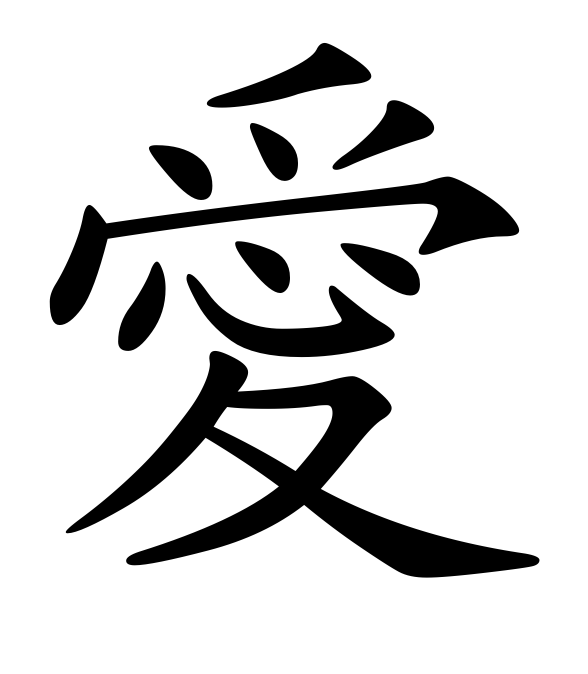
愛 爱 Love Chinese character etymology and structure


A friend of mine, a western native speaker of Mandarin Chinese, who grew up in Taiwan, recently embarked on the journey of learning how to read Chinese. He sent me a few pages of a book that he is reading to help him understand the Chinese writing system better and asked for my opinion. 

A few minutes of reading it turned into a few hours of thinking, writing and research and I thought I would publish my reply to him about one specific section in this book as an article on my blog as it covers a few interesting concepts and recurring themes. 

In the introduction, the author uses the character 愛 as an example to teach his students that quote "100% (not a single exception) of Chinese words is composed of root words. (sic)". The author's writing is a bit difficult to understand, and there was context before and after this sentence that would make it a bit clearer, but what the author essentially tried to say was that with every single Chinese character, it is possible to tell what this or that Character means just by understanding what roots it consists of, which can always be seen clearly in the character itself. A simple example would be looking at the Chinese character 人 and seeing that it is a person. 

The author then proceeds to further demonstrate this with the character 愛 and as we will see, his system unfortunately falls apart. He writes:

愛 (love) is the composite of (sic):

1. Top part of 受 (receiving) which means holding hands (sic)

2. 心 (hearts (sic))

3. Bottom part of 夏 (Summer) which means walking slowly (sic).

So love is that hearts hold hands and walk slowly together (sic).

I think it should be obvious that this is storytelling and not scientific research, and I think it is also important to prove why the author is wrong. 

First of all, arbitrarily deciding that the 愛 character is formed by ripping off the top of 受 and the bottom of 夏 and putting a 心 between them because it fits our explanation is like working with a completely faulty set of equations while solving a math problem and then arbitrarily changing the resulting number after the equal sign to the one we want manually so that it fits our teacher's correct result. 

As for the etymology of 愛 I never researched this character before, I convened my little etymology research team consisting of me and my TW friend:) and this is what we found out:

First, let's make the character a bit bigger:


Just by looking at it we cannot really tell what elements/roots/radicals/standalone characters etc. the character 愛 is made of, as the author says. We see 心 xin1 - heart in the middle, we see 夊 sui1 - walk slowly at the bottom. The top however is 爫over 冖 which is clearly a simplification/fusion of something that was there before but we cannot recognise it now. 

January 31, 2022

My random thoughts on language learning

My random thoughts on language learning 


Mastery/no blind spots

Inspired by Salman Khan, while learning a particular concept, try to learn in a way that you understand everything you are learning perfectly with no ‘blind spots’ in your understanding. In other words, if tested on what you are learning, you should get 10/10, ten times in a row. It seems, that the information you learn needs to be perfectly understood by your brain so that it can turn into a solid, automatic, functional block quickly. 

Additionally, you can’t just learn something and know how it works roughly. It’s like learning what the gas and brake pedals do, but not learning what the clutch does and then in the next lesson being taught how to parallel park. Obviously I need to know what the clutch does before I can do that. 

Law of distributed burdens*

It is wise to divide brain-intensive operations into separate, more manageable chunks. While logical, it’s unfortunately not obvious and this strategy has helped me many times deal with brain intensive operations, not only when it comes to language learning. 

For instance, it is very inefficient to learn Chinese by learning how to read, write, speak and understand the language all at the same time. If you distribute the burden, say, learn how to read in pinyin first, then move on to listening, then move on to text-chatting in pinyin, then to speaking, then to reading Chinese characters, then to learning how to type Chinese characters and finally to handwrite, the task will be much more manageable.

This approach can be applied to lower levels of language learning too. For instance, it is more efficient to try to improve your pronunciation one sound at a time rather than try to improve several sounds at once. It’s for instance more efficient to consciously accept that you are not pronouncing the Spanish ‘r’ correctly and leave the improvement of this sound until after you’ve become somewhat fluent in the language. Working on both improving the ‘r’ sound while trying to improve your general fluency at the same time might be overloading the brain and actually slowing down the progress towards fluency itself considerably.  

*I don’t have a better name for this concept unfortunately but I hope it will do. 

July 16, 2021

Interesting ideas from the Lex Fridman Podcast


About two months ago I discovered the wonderful Lex Fridman podcast. It has kept me company most of my days since then and has made me pause and think about what was said by Lex or his guests and life in general really about a hundred times, thinking about some of the ideas mentioned long after the podcast was over.

As a tribute to this wonderful intellectual work, since I wrote some of the ideas I found really interesting into my little notebook, I wanted to post them as an article.

I intentionally didn't attribute individual thoughts or paragraphs to their authors (I did attribute them as a group at the end of the article) and there is a reason for that. I've been experimenting with a new concept (at least for me). I noticed that when I read an article by someone and don't know who wrote it or when I listen to a podcast and do not know anything about the person speaking, it's a completely different intellectual experience for me than when I know at least something about that person. Even seeing the picture sets up a certain preconception in my mind. When I know nothing about the person, I am much more open to that person's ideas, listen/read with much less prejudice and just have much less preconceptual junk in my mind influencing my listening in general.

When I listen to Lex's podcast (or any podcast) now, I skip the guest introduction, and let the 'ideas sell themselves'. I might read up on the guest afterwards, but not before the interview and I am trying to do this with articles I read as well (where possible). I have to say it really is a whole new intellectual experience:)

June 17, 2021

Online superorganisms


Tim Urban's Tweet

A while ago, one of my favorite bloggers, Tim Urban, tweeted a tweet in which he expressed sadness about the fact that Nature (the scientific magazine) was posting too much political content. 

As it unfortunately often is the case today, this, in my opinion innocent tweet, caused an all out war in the comment section with dozens of people attacking him. 

This being sad, but not surprising, I noticed one other thing however. Consider this tweet: (I intentionally deleted the parts that would identify the topic so that I wouldn't get accidentally flamed as well:)

"Come on Tim, you are better than that...remember when you published that multipart hagiography of Elon Musk on yours? What happened to you, dude?? Tim you're better that this. You've had some pretty yikesy takes lately. Hoping it's just a phase and I legitimately don't see the problem here. Very silly tweet. Even if that was a mistake—and I very much hope it was—you’re coming across as what you once called a zealot. ....is this performance art?"

What is interesting about it is, that it is actually not one tweet. These are 10 tweets posted by 10 different people which I pieced together. To me they legitimately seem like written by one person. 

Diverting slightly, more and more I've been thinking about the fact that people connected to the internet have turned into this huge neural network where each one of us is acting like a single neuron in that network. 

December 21, 2020

Some thoughts about my dear book about Chinese Characters


Several years ago I wrote a book about Chinese characters called Understanding Chinese Characters. What started out as small research for my personal study purposes turned into this gigantic project that took more than 5 years of very intensive research and writing to complete and even though I did most of the work alone, there were almost 30 people involved helping me. Many many thanks to them, especially those who were very involved and the book could never have been finished without them. When I was done I was so tired and burned out, that even though I managed to push the book over the finish line with 100% diligence, after I self-published, I had no energy left for promotion whatsoever. 

I'm not a sales person anyway and I feel very uneasy when I have to talk about something I did not to mention promote myself or a product or an idea I worked on, so I submitted the book only to one publishing house and when I got rejected (which happens all the time and I accepted it normally) I only put the book on my blog and let it live it's own life. 

I am very surprised and happy that to this day with basically zero promotion and with the book being hidden on my blog there were almost 200 people who were interested in it enough to buy it. Many thanks to everyone who did.

In either case, the reason why I'm writing this article now is because a reader left a comment under the article where I talk about my book and asked a few questions, the most important being: how is my book different from all other books about Chinese characters? 

A lot of time has passed since my Chinese character burn out and when I read his comment I realized that a reader who doesn't know my work from my Understanding Chinese Characters youtube channel really does not know why I think my book is the best book about Chinese characters ever written! :) All jokes on me. 

He mentioned one Russian book to me and told me that to him it essentially looks the same as mine except for the colors and I have to agree. On the surface and without any explanation the two layouts do look similar:

December 05, 2020

Discussions with my Slovak-born Chinese friend about tones in Mandarin Chinese

Recently I've been going to my friend's Chinese restaurant every Saturday to eat and have a good time for a few hours with my local Slovak-Chinese friends.

I've been always fascinated with perfectly bi-lingual and bi-cultural people - the more complex or unexpected the combination the better. My friend's parents are from the ZheJiang province in South-East China. He was in China for 3 years from 6 to 9 years old to learn Mandarin (until then he only spoke his local ZheJiang dialect at home with his parents) and came back to Slovakia right before he would have learned anything about the structure of Mandarin in Chinese schools as Chinese students do.

He speaks Mandarin completely by feel, at a native level, albeit with a limited vocabulary and sometimes limited expressions, but at a native level. He speaks Slovak better than Mandarin. He feels more Slovak/European than Chinese. 

Since I started learning Mandarin, I was always most curious about how native speakers perceived tones, how and whether at all they think about them when they speak and it was quite difficult to talk about this to educated Chinese native speakers, because they all had learned about the structure of Mandarin in school which influenced their perception. 

My friend however knows nothing about Mandarin structure, speaks it intuitively and the following, to me fascinating, discussion took place:

November 28, 2020

Substance and Form


When I was younger, say between 13 and 21, to a great extent, I was much better at speaking foreign languages because I didn't really care that much about what I was saying :) 

To me it was important that I had a good accent, that I sounded like a native speaker and it was often at the cost of substance - the actual message I was delivering and the way I was structuring it. I might have sounded 100% like someone from New Jersey, but if you paid close attention to what I was saying, it wasn't very coherent. Now, provided, I was young at that time I wouldn't expect my younger self to be very coherent in the first place but I think I would have had struggled even if I had tried. 

As I got older, I started to realize that substance was actually quite important. Surprise (笑). As a lot of people, I imagine, I realized that most of what I was saying, no matter how complicated, was just a resonance of what was said around me. Almost everything I was saying and even thinking was something I'd heard from someone else before, only gravitating to those thoughts and language that was appealing to me and not forming it myself. 

June 15, 2020

How polyglots learn foreign languages - University research questionnaire


Hello everyone,

a university student from Finland asked me if I could answer some questions for his Master's thesis about how polyglots learn foreign languages. It's not like I get flooded with requests like this every day. I am very honored, that someone would like to hear my opinion for academic research and every time I am asked to summarize how I learn I feel like I get better and better at summarizing something I have no idea how to summarize :) 

I suspected my answers would turn into a small essay so I decided to post the text as an article for anyone interested as well.

Vladimir


1) Mother tongue(s): 

Slovak/Czech, Hungarian


2) Enlist the languages you know and evaluate the level of each according to the Common European Framework of Reference for Languages, eg. Spanish C1 etc. (descriptions of the levels available on the last part of this questionnaire).

Current level:

Slovak C2
Czech C2
English C2
Mandarin C2/C1
Spanish C1
Italian C1
German C1
Russian C1

Hungarian B2
French B2
Portuguese B1

Classical Chinese B1
Latin B1

I learned other languages as well, but my current level in them is very poor. Maybe worth mentioning only might be, that when I was more involved with languages, apart from the above, I was able to hold a decent conversation without having to switch to English in: Polish, Serbian and Persian.

May 30, 2020

Are Simplified Chinese Characters really that new?


The great majority of Simplified Chinese characters* were created during the simplification process in the 20th century in the PRC. What is however probably not very well known is that a lot of what we call Simplified Chinese Characters today are characters that are very old themselves.

These characters may have originally had meanings that were not the same as the characters they replaced in the simplification process, or they sometimes were alternative modern or older versions of the same character but in either case, these Simplified Characters existed for a very long time in history as well (as will be shown, often for more than 2500 years).

The point of this post is not to argue that all Simplified Chinese characters are old, or praise their age and neglect the fact that they don't corrupt the phonetic and semantic elements of Traditional characters they replaced. I'm simply stating an interesting fact and addressing the common misconception that all Simplified Chinese characters were created ad hoc in the in the simplification process in the 20th century.

Furthermore, the simplification in the 20th century by the PRC government wasn't the first one in Chinese character history. There were several ones, some large-scale and systematic, others having the nature of random improvements, with the 20th century one being the most recent one. These previous simplifications also often corrupted individual character elements rendering them irrecognizable as will be shown below.

To name just a few all following Traditional characters had previously been simplified with their originals clearly containing recognizable phonetic and/or semantic elements:


Original meaning "to harvest grain" formed by 禾 (meaning grain) and 千 phonetic (pronounced qian1) originally written as 秊
https://ctext.org/dictionary.pl?if=en&char=%E5%B9%B4


Original meaning "outer side of garment" formed by 衣 semantic (meaning "clothes") and 毛 phonetic (pronounced mao2) originally written as 𧘝
https://ctext.org/dictionary.pl?if=en&char=%E8%A1%A8

October 18, 2019

Language Trivia

Hello everyone. I made a list of language-related questions for a friend of mine for a trivia game and I thought I would post the questions here for fun.

The rules are:

A) No google:)
B) If you get the whole question right, you get a point
C) Feel free to write your answers in the comments

Here are the questions:

1) Name the three largest Indoeuropean language families in Europe

2) Name 5 major Germanic languages

3) Name 5 major Romance languages

4) Name 7 major Slavic languages

5) Name 3 major Ugro-Finnic languages

September 16, 2019

Impossible tasks and bad techniques

If you see someone trying to lift a 500 kg stone with rollerblades on their feet, maybe knowing that that person had never done any exercise in their lives before, it's clear to you that that person will not lift the stone.

Firstly, the stone is just too heavy and secondly, it's really a dumb idea to try to lift it with your rollerblades on.

Unfortunately, the way people are trying to achieve language proficiency in some languages, is something you cannot see with your eyes, and a lot of people simply don't realize that either the goal they are working towards is impossible to achieve or the methods they are using will not work.

Some very difficult languages just cannot be learned to a satisfactory level with current methods. It's just like trying to lift that very heavy rock with rollerblades on.

So..if you are learning a language and are not making progress the problem might not be your lack of talent, but rather the fact, that with the methods you are using, you just objectively cannot learn what you are trying to learn.

August 29, 2019

Multilevel text analysis

Sometimes people ask me whether I use any special methods to learn languages so quickly and so well. These are their words, not mine:) I think language learning is very difficult, takes forever and I think I make a ton of mistakes in every language I speak including my native language. I used to say that talent, passion, focus and a lot of time are probably what influence my results most, but there are also a few methods that I like to use and I wanted to write about one today.

When I'm learning a new language, I like to analyze it on my own. The usual way I used to go about this was to make notes directly into the text I was reading, but this would get messy very quickly, especially when I knew very little or nothing about the language, because I needed to take a lot of notes:

My notes on Caesar's Commentaries on the Gallic wars. Latin.

The advantage of this approach for me is, that I can write notes or translations of the text I'm analyzing directly into the text in any language I feel fits the translation/analysis best. If, for instance, in the text I come across a noun in accusative, I write the translation of that word into my native Slovak, because it also has an accusative and represents the form of the Latin original in my mind perfectly. If it's some strange verbal form, I usually write the translation in Italian (or English), since its verbal system is quite complex and derived from Latin and I usually can find a very good match. If it's some rare expression, I usually translate it into English or Slovak, since my vocabulary base is best in these two languages.

May 10, 2019

Learn to read Chinese with manga


Hello everyone,

I started an experimental series on Youtube called Learn to read Chinese with manga. Feel free to check it out if you like.

I found reading to be a fantastic aid which helped me learn most of the languages I speak because of the following:

  • the language is 'frozen in time'. When you listen to something, even if it's a recording that you can rewind, words flow very quickly. When you are reading something, the language is frozen and laid out on the pages you read and you can read whatever you want at your own discretion. 
  • you can look for patterns in the language (crucial for learning a foreign language) much more effectively, because you can quickly compare something you see on page 7 with what you saw on page 3 etc. enabling you to get to your Aha! moment quicker
  • you can make notes directly onto the page you are reading
  • you have more time to analyze the structure of the language because you don't have the speed of the language to fight with
  • you can constantly return with your eyes to the Aha! words/constructions on the page you are reading (repetition - crucial for remembering new information)
I also found that when reading a foreign language, the absolute best thing ever is, when beneath the text I have a literal translation of what is written word by word in Neanderthal and then a translation of the same thing in nice English, as it should be said by an educated native speaker like so:

Latin  Praeterea se neque sine exercitu in eas partes Galliae venire audere, quas Caesar possideret, neque exercitum sine magno commeatu atque molimento in unum locum contrahere posse.
Neanderthal Moreover himself neither without an army into those parts of Gaul to come to dare, which Caesar possessed, nor an army without great supply and difficulty into one place to bring together to be able
Nice English That, besides, neither dare he go without an army into those parts of Gaul which Caesar had possession of, nor could he, without great expense and trouble, draw his army together to one place

If you are reading something on your own, the most tedious task is to work out the Neanderthal version and the nice English version on your own.

All of the above is exactly what I am trying to achieve in this video series:

March 24, 2019

Fluency staccato


What I call Fluency staccato is a phenomenon where due to constant back checking and constant active concentration on the most elementary parts of speech you loose focus and are unable to form natural longer sentences which would still make sense. The reason is that you run out of 'attention currency' (for more information on this topic watch the wonderful TED talk by Apollo Robbins https://www.youtube.com/watch?v=GZGY0wPAnus) as there's only a limited amount of things you can concentrate on consciously at the same time.

Anything you concentrate on consciously (like grammar rules, sentence structure, pronunciation etc.) costs you a certain amount of Attention currency and your budget is limited. If you, as will be the case in this article, spend too much of it on individual morphemes, while at the same time you have to concentrate on pronunciation, syntax, the vocabulary you want to use etc. you very quickly run out of cash and you have nothing left for other very important things like: the actual thought you want to convey. Your sentences will at best not connect to one another, at worst, what you say will only be natural on a sub-sentence level.

I was inspired to write this article because a native speaker of Mandarin Chinese left the following comment under one of my videos, and reminded me how destructive it is to learn a distant language starting from it's most elementary parts (tones for Mandarin learners, articles for learners of English, case endings for learners of Russian etc.):

As a native speaker, my advice is that you'd better start off with individual characters rather than words. Although starting with learning a bunch of words helps you put up sentences easier you will get confused soon after passing the beginner level because the Chinese language at its core is the meaning for each individual character. Though nowadays characters usually appear combining with other characters forming into words the meaning of a word is still defined by the characters within. Words with the same character can carry drastically different meaning but the meaning of that particular character may stay the same. For example, in the following two words contain the same character "所" but they have different meanings. 场所:a place ; 厕所:restroom ;  if you try to remember all the words with a "所" it is quite confusing and when a "所" pops out in a sentence it causes problem. However, if you know that the character "所" generally speaking means "a place" it will be much easier. for “场所” since both of the characters mean "a place" the word means 'a place'. for "厕所" the first character means the things you would do in a restroom combining with "a place" therefore this word means restroom. Then whenever you run into a "所" you can guess it is talking about a place except for one occasion that I can think of "所以" which means 'so' or 'therefore'.

I answered the comment and a few interesting things came out of it:

Hello. You are a native speaker of Mandarin and never had to learn Mandarin and without a lot of teaching experience you unfortunately cannot understand what problems foreigners learning Mandarin face and in what order they have to tackle them. It's the same situation when foreigners are trying to learn my native language. I have no idea what they need to know and in what order simply because I never had to learn my own language.

Your method would lead to poor results in my opinion because of this: