A few minutes of reading it turned into a few hours of thinking, writing and research and I thought I would publish my reply to him about one specific section in this book as an article on my blog as it covers a few interesting concepts and recurring themes.
In the introduction, the author uses the character 愛 as an example to teach his students that quote "100% (not a single exception) of Chinese words is composed of root words. (sic)". The author's writing is a bit difficult to understand, and there was context before and after this sentence that would make it a bit clearer, but what the author essentially tried to say was that with every single Chinese character, it is possible to tell what this or that Character means just by understanding what roots it consists of, which can always be seen clearly in the character itself. A simple example would be looking at the Chinese character 人 and seeing that it is a person.
The author then proceeds to further demonstrate this with the character 愛 and as we will see, his system unfortunately falls apart. He writes:
愛 (love) is the composite of (sic):
1. Top part of 受 (receiving) which means holding hands (sic)
2. 心 (hearts (sic))
3. Bottom part of 夏 (Summer) which means walking slowly (sic).
So love is that hearts hold hands and walk slowly together (sic).
I think it should be obvious that this is storytelling and not scientific research, and I think it is also important to prove why the author is wrong.
First of all, arbitrarily deciding that the 愛 character is formed by ripping off the top of 受 and the bottom of 夏 and putting a 心 between them because it fits our explanation is like working with a completely faulty set of equations while solving a math problem and then arbitrarily changing the resulting number after the equal sign to the one we want manually so that it fits our teacher's correct result.
As for the etymology of 愛 I never researched this character before, I convened my little etymology research team consisting of me and my TW friend:) and this is what we found out:
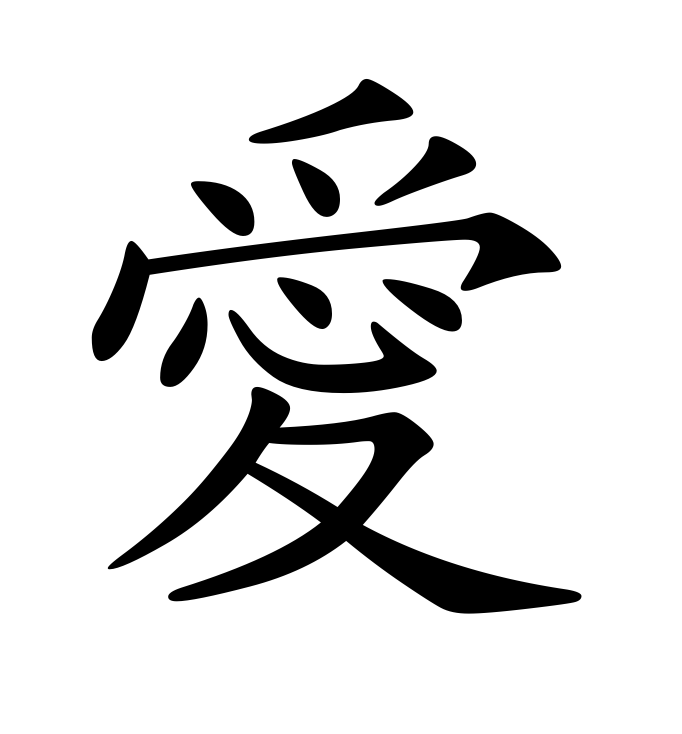
First, let's make the character a bit bigger:
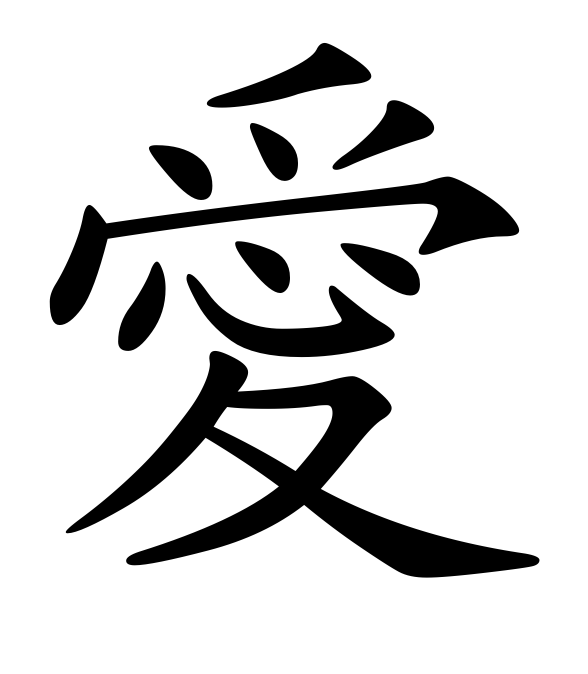
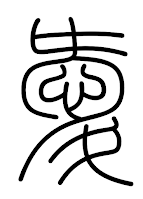
Another datapoint is to try to find a more conservative Regular script version of 愛 which we found:
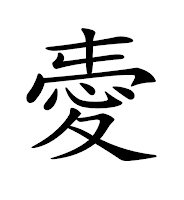
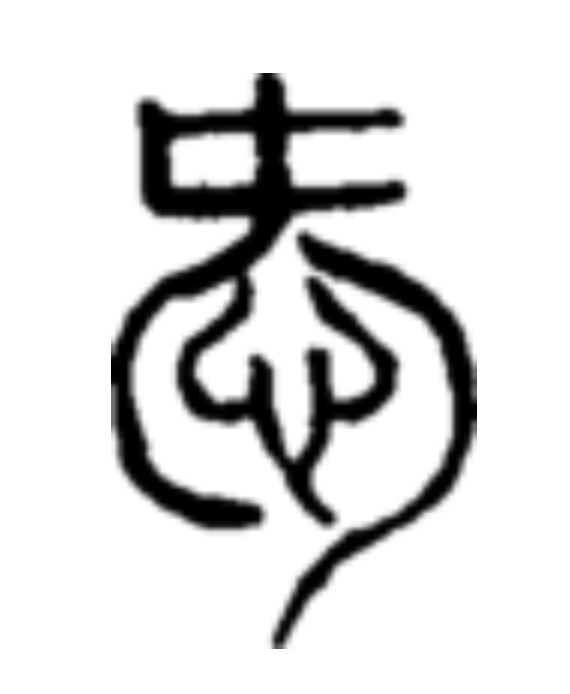
over
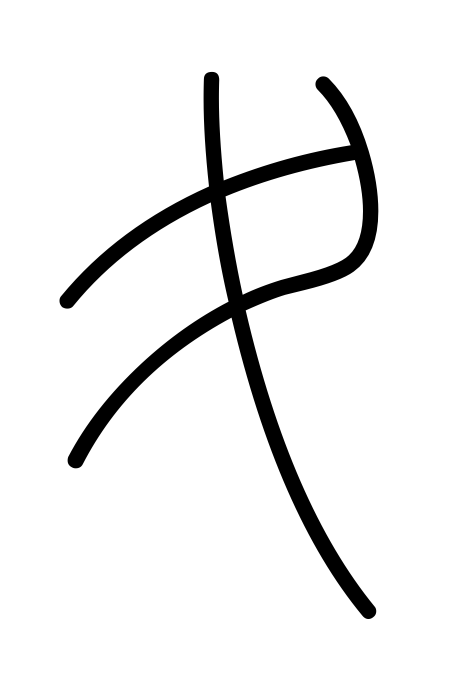
Doing a reverse search from the Seal script to the Regular script, we can see, that these really are the 㤅 ai4 phonetic over the 夊 sui1 - "walk slowly" semantic in the regular script as mentioned in 說文解字 so the definition is correct and we can say that:
愛 is a phono semantic compound character, which originally meant "a type of an appearance a person has when walking", now it means "love", how it got this meaning we do not know and it consists of 㤅 ai4 phonetic over 夊 sui1 - "walk slowly" semantic, which when combined, the top of 㤅 was simplified to 爫over 冖 arbitrarily so that the end result now is 愛.
The simplified character 爱 is then a further arbitrary simplification of the elements in 愛 and it is fair to stress that the traditional 愛 is already a simplification of 㤅 over 夊.
Interestingly, 㤅 itself used to mean 'love' and is formed by 旡 ai4 phonetic over 心 semantic. Btw, interestingly, the bopomofo for "ai" is ㄞ which is similar to 旡 ai4, but that's probably just a coincidence.
This research took about 45 minutes and was done by me and my Taiwanese friend who have experience doing this, just to give you an idea about how difficult it is to prove the etymology of this or that character. Especially fused ones. I wanted to write this article also because face-value storytelling and poetic explanations of the structure of Chinese characters are commonplace among native Chinese speakers and foreigners alike and I would like to gradually bring awareness to the fact that Chinese character etymology is actually a real science and an established scientific field and shift the understanding of how Chinese characters actually really work from this sort of prolific storytelling to logical fact-based and rigorous science.

greetings from russia, your creativity is great!
ReplyDeleteThank you:)
DeleteFor some reason I stopped getting newsletters, but I resubscribed for good articles like this. Thank you
ReplyDeleteHi Bea. Thanks for the comment. I'll resend the newsletter again.
DeleteThank you - wonderful work !
ReplyDelete"a type of an appearance a person has when walking"
ReplyDelete... is it a specific "type of appearance" ?
My mind instantly goes to 上を向いて歩こう, but that's just my own storytelling.
How would this be used in a sentence? (before the meaning changed to 愛してる)
That "definition" seems to be missing some very important information.
說文解字 definitions are not long by design. The entire entry for 愛 in 說文解字 is just:
Delete行皃。从夊㤅聲。
Translation: Type of a walk. Consists of 夊 semantic and 㤅 phonetic.
Even though back in the times the 說文解字 was written, many of these definitions were probably much clearer to those writing and reading them, still I find the dictionary just gives the absolute minimum functional definition like: river, bird, tree type, Northern Barbarian etc.
Which river? What bird exactly? What tree type? Which Northern Barbarian exactly?
I did a bit of reading now and the oldest reference I could find for 愛 as 愛 with the meaning 'to love' goes back to 論語 in
子曰:「道千乘之國:敬事而信,節用而愛人,使民以時。」
As for 愛 as 㤅 especially in the meaning 'type of walk', I didn't find anything, which might mean 1) I would need much more time to go through old texts, scans, dictionaries etc. manually 2) There is something wrong with the definition 行皃。从夊㤅聲 itself.